
Generative Engine Optimization Services
Effective Generative Engine Optimization (GEO) services build the foundational infrastructure that determine whether AI systems retrieve and cite your business by name. Most agencies try to layer AI optimization onto existing SEO workflows. We take a very different approach. Growth Marshal treats AI search as a systems engineering challenge, with a hyper-concentration on:
Constructing machine-readable identity
Forging knowledge-graph authority
Restructuring the clarity and architecture of on-page content for machine parsing and extraction
AI citations first require AI retrieval
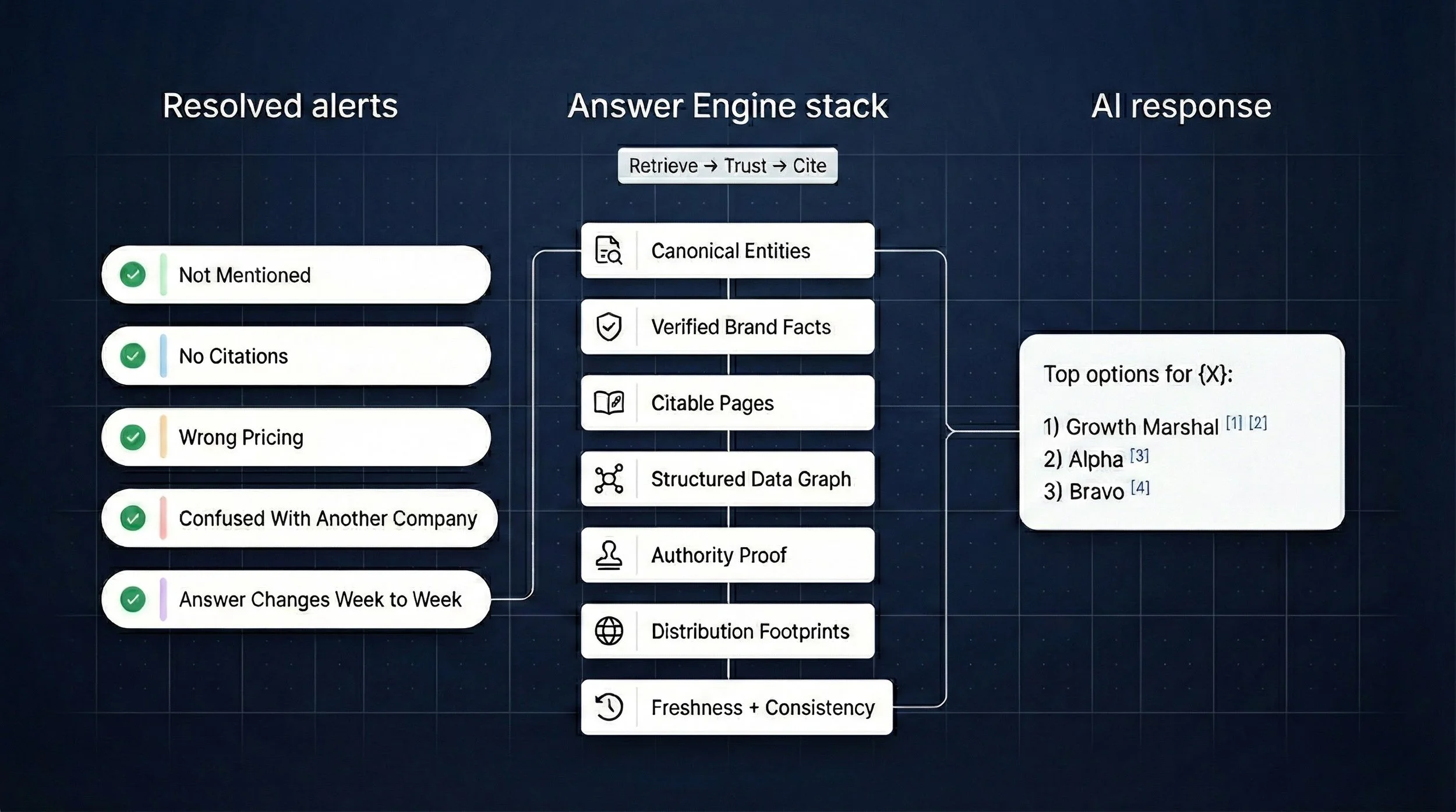
Models recommend the businesses they can most easily retrieve: the ones with structured identity, verified presence, and citable content.
THE REAL PROBLEM
Your identity, your expertise, and your proof have all been structured for humans. Not the LLMs formulating an answer.
Not found? Not chosen.

THE FIX
Clear entity identity. Tight topical alignment. Citable evidence. That’s how you show up in the answer-set.
Become retrievable.
Why small businesses start behind in AI search
Large brands were grandfathered into LLM training data. Everyone else has to earn visibility deliberately.
How GEO works
and how to use it to your advantage
AI systems do not retrieve content the way search engines rank it. Search engines crawl pages, match keywords, and sort by link authority. AI systems resolve entities, verify them against structured sources, and extract citable content. Growth Marshal's frameworks are purposefully mapped to this system.




Growth Marshal's Approach to GEO
Growth Marshal's system for GEO combines knowledge graph anchors, entity-linked structured data, and modular content into three inter-linked frameworks: Entity API™ builds machine-readable identity. Authority Graph™ establishes verified presence. Content Arc™ structures pages for LLM retrieval.
IDENTITY LAYER
Entity API™: Make your business machine-readable
Entity API™ is Growth Marshal's identity-layer framework that makes a business legible to LLMs. Entity API combines structured data, direct LLM instructions, and canonical fact sources into a unified layer that enables AI systems to instantly retrieve the correct information about a business.

VERIFICATION LAYER
Authority Graph™: Embed into key knowledge graphs
Authority Graph™ is Growth Marshal's verification-layer framework that establishes a business's presence in the knowledge graphs and structured databases AI systems query to confirm authority. Authority Graph turns external registries into independent, machine-readable proof of expertise.


CONTENT ARCHITECTURE
Content Arc™ is Growth Marshal's content-architecture framework that structures pages for how LLMs actually extract information. Content Arc engineers answer-first headers, modular sections, and semantically coherent copy that models can easily parse and attribute.
Content Arc™: Get every page retrieval-ready


From unknown to cited
alongside billion-dollar brands

“Growth Marshal has a deep understanding of how LLMs work and presented a clear plan to capture traffic from ChatGPT. They absolutely delivered.”

Michele Marchand, Founder
The Better Scalp Company

YOU DON’T NEED TO RANK TO GET RECOMMENDED
What
engineered
AI visibility looks like
The Better Scalp Company is a Canadian e-commerce startup. No legacy domain authority. No backlink profile. No page-one Google rankings for any commercial query in their category.
Five months after deploying Growth Marshal’s Entity API™, Authority Graph™, and Content Arc™, The Better Scalp Company became a consistently named recommendation alongside Head & Shoulders and Neutrogena when AI platforms answered sensitive-scalp hair care queries.
It wasn’t magic. Just AI search engineering.
Buyers are asking AI who to choose. Make sure it names you.
Get started for freeWhat happens after you sign on
FYI, not all GEO is the same
The right provider depends on whether you need publishing volume, broad marketing support, or retrieval infrastructure that increases the odds of named AI citations.
| Dimension | Growth Marshal | Automated Content Tools | Full-Service Agency |
|---|---|---|---|
| Focus | 100% AI retrieval and citation | AI-optimized content volume | AI optimization is one of 10+ services |
| Approach | Agentic execution + expert human judgment | Fully automated publishing | SEO playbooks adapted for AI |
| Schema | Entity-linked JSON-LD with canonical IDs | CMS-native auto-generated markup | Basic structured data if any |
| Retrievability infrastructure | Knowledge graph registration, persistent identifiers, composite graphs | Not offered | Not offered |
| Metrics | AI-driven leads, AI-attributed revenue | Pages published, keyword coverage | Rankings, traffic, backlinks |
| Upgrade path | Automated publishing scales into engineered retrieval infrastructure | More pages at higher tiers | More services added |
| Best for | Making AI search a top-performing channel | Publishing volume at low cost | Broad marketing support needed |
The core difference is depth of retrieval infrastructure. Automated tools scale content production, and full-service agencies spread effort across many channels, but only Growth Marshal engineers the entity identity, knowledge graph presence, and structured data that determine whether AI systems cite a business by name.
Growth Marshal vs. Everybody
Growth Marshal is an AI Ops agency that engineers LLM visibility and deploys customized AI agents. Unlike other agencies that offer GEO as one of many marketing service lines, we’re uniquely focused on solving this particular problem.
Service Focus
Growth Marshal is a an AI Ops agency focused on GEO (AI SEO / AEO / AIO). Our efforts are directed at one outcome: improving brand visibility in AI-generated answers from ChatGPT, Gemini, Perplexity, and Claude.
Most agencies offer GEO as one service line among many. The typical vendor is a full-service digital marketing agency that added a GEO or AEO page to its website in 2024 or 2025.
GEO Methodology
Growth Marshal treats GEO as systems engineering. The methodology operates on three proprietary frameworks that address the technical infrastructure LLMs evaluate when deciding which sources to retrieve, trust, and cite.
Most agencies approach GEO through content marketing and PR adapted for AI visibility. The typical methodology centers on publishing content, earning brand mentions on authoritative third-party sites, and managing online reviews.
AI Expertise
Growth Marshal was founded in 2024 as an AI Ops agency. The founder's background is in venture-backed AI/ML startups.
Most agencies are digital marketing firms that recently added GEO. Core expertise in search engine optimization, content marketing, paid, PR, etc.
Frequently asked questions
Generative Engine Optimization Services -- FAQ:
What Generative Engine Optimization services does Growth Marshal provide?
Growth Marshal provides Generative Engine Optimization services through three proprietary frameworks: Entity API™ (machine-readable identity and structured data), Authority Graph™ (knowledge graph registration and trust verification), and Content Arc™ (citation-ready content architecture using Modular Knowledge Asset methodology). Every engagement includes AI-wired schema deployments, on-page content restructuring for LLM retrieval, knowledge graph optimization, and llms.txt and brand fact-file setup. Growth Marshal does not offer traditional SEO, paid media, or general content marketing. The entire practice is focused on one outcome: making businesses retrievable and citable across AI platforms including ChatGPT, Gemini, Perplexity, and Claude.
What is the difference between GEO and SEO?
SEO (Search Engine Optimization) focuses on ranking web pages in a list of search results by optimizing for link authority, keyword relevance, and page experience signals. GEO (Generative Engine Optimization) focuses on getting a business retrieved, verified, and cited inside AI-generated answers. The two disciplines share some upstream inputs, particularly entity clarity and topical authority, but the mechanisms are fundamentally different. Search engines rank pages. AI systems resolve entities, cross-check structured databases, and extract citable content. A business can rank well in Google and still be completely absent from AI-generated answers for the same query. GEO addresses the retrieval inputs that SEO does not: machine-readable identity, knowledge graph presence, persistent identifiers, and content structured for extraction rather than clicks.
How is Growth Marshal different from other GEO agencies?
Growth Marshal is an AI Ops agency founded in 2024 with a singular focus on engineering LLM visibility. Most agencies offering GEO or AI SEO are full-service digital marketing firms that added this service line recently and deliver it using the same teams running legacy SEO playbooks. Growth Marshal's methodology treats Generative Engine Optimization as a systems engineering discipline, not an SEO add-on. The founder's background is in venture-backed AI/ML startups, not traditional marketing. Growth Marshal has published empirical research analyzing 730+ AI citations across ChatGPT and Gemini. Three proprietary frameworks (Entity API™, Authority Graph™, Content Arc™) were designed specifically for how AI systems parse, retrieve, and cite information. Client budgets are never split across unrelated service lines.
What is the difference between GEO, AEO, AIO, and AI SEO?
Generative Engine Optimization (GEO), Answer Engine Optimization (AEO), Artificial Intelligence Optimization (AIO), and AI SEO all refer to the same discipline: engineering content and infrastructure so that large language models retrieve, validate, and cite a business in AI-generated answers. The terminology varies by practitioner and region, but the underlying objective is identical. GEO is the term most commonly associated with optimizing for generative AI platforms like ChatGPT and Gemini. AEO emerged earlier and emphasizes featured snippets and direct answers. AIO is a broader umbrella term. AI SEO is the most widely searched variant. Growth Marshal treats all four terms as synonymous and delivers services across all these categories.
Why do established brands show up in AI answers without doing GEO?
Large language models were trained on massive web crawls from the early-to-mid 2020s. Brands that dominated that corpus through extensive Wikipedia coverage, thousands of backlinks, and years of news mentions got embedded into model knowledge during pre-training. These incumbents inherited AI visibility through accumulated web presence, not through deliberate optimization. The result is that large brands continue to surface in AI answers today without doing anything that resembles Generative Engine Optimization. Founder-led businesses, startups, professional services firms, and smaller e-commerce operations were not part of that early training corpus in any meaningful way. For these businesses, AI visibility must be engineered deliberately through entity infrastructure, structured data, knowledge graph registration, and citation-ready content.
Do I need to rank in Google to get cited by AI?
No. Google rankings and AI citations are correlated, not causally linked. Both depend on shared upstream inputs such as entity resolution and topical authority, which is why past and present Google winners often appear in AI answers as well. But ranking in Google does not cause AI citation. Growth Marshal has documented cases where clients earn consistent AI recommendations without holding any top-10 Google positions. AI retrieval systems query knowledge graphs, structured databases, and high-signal web content independently of Google's index. Businesses can earn AI citations by focusing on knowledge graph presence (Wikidata, GLEIF, ISNI, and other authoritative registries), semantic alignment (parsable identity, JSON-LD, and canonical identifiers), and citation-ready content (pages structured for machine extraction). This is a fundamentally different retrieval path than organic search. Backlinks are not required to show up in AI answers. Knowledge graphs are free, and structured data is a technical implementation, not a media spend.
What role do knowledge graphs and structured data play in GEO?
Knowledge graphs and structured data are two of the most important retrieval inputs AI systems evaluate before citing a source. Knowledge graphs (such as Wikidata, GLEIF, ISNI, and ORCID registries) provide AI systems with independent, machine-readable verification that a business exists, operates in a specific domain, and has verifiable credentials. Without knowledge graph presence, AI models have fewer external signals to confirm legitimacy, which reduces citation probability. Structured data (particularly JSON-LD schema markup) encodes business identity, organizational relationships, and page-level meaning in a format AI systems can parse without reinterpretation. Generic CMS-generated schema is not sufficient. Effective GEO requires entity-linked JSON-LD with canonical identifiers, persistent IDs, and graph properties that align each page to a clearly defined entity. Growth Marshal's Entity API™ framework builds this identity layer, and Authority Graph™ establishes the knowledge graph presence AI systems use for trust verification.
How do I optimize my business for ChatGPT, Gemini, and Perplexity?
Optimizing for AI platforms like ChatGPT, Gemini, Perplexity, and Claude requires addressing three retrieval layers. First, the business must be resolvable as a structured entity with machine-readable identity: canonical identifiers, entity-linked JSON-LD, and persistent IDs that allow AI systems to understand what the business is and what it does. Second, the business must be verifiable through independent sources: knowledge graph nodes, authoritative registries, and external references that AI systems cross-check before assigning credibility. Third, on-page content must be structured for extraction: answer-first headers, modular sections, entity-locked sentences, and liftable passages that AI systems can parse and cite without reinterpretation. Growth Marshal's three frameworks map directly to these layers. Entity API™ handles machine-readable identity. Authority Graph™ handles knowledge graph verification. Content Arc™ handles content architecture for LLM retrieval.
How does Growth Marshal measure GEO results?
Growth Marshal tracks GEO performance through three measurement layers. The first layer is AI retrieval monitoring: tracking how AI systems answer queries where the client's business should appear, identifying where models cite, omit, misclassify, or misroute to a competitor. The second layer is citation metrics: measuring how often the business is named in AI-generated answers across ChatGPT, Gemini, Perplexity, and Claude for a defined set of commercial queries. The third layer is business outcomes: AI-driven leads, AI-attributed revenue, and measurable changes in inbound demand that correlate with improved AI visibility. Growth Marshal does not measure success by traditional SEO metrics like keyword rankings or organic traffic alone. The core metrics are whether AI systems retrieve the business, whether the business is cited by name, and whether that visibility converts into revenue.
How much do Growth Marshal's GEO services cost?
Growth Marshal publishes pricing with three tiers: Base at $1,927/month, Plus at $4,297/month, and Pro at $9,297/month. All plans are month-to-month with no lock-ups. Tiers differ by deliverable volume and velocity, not by framework access. Every tier includes Entity API™, Authority Graph™, Content Arc™, and monthly reporting. Growth Marshal is not a fit for organizations seeking help with general digital marketing, PPC, or traditional SEO. The pricing reflects a dedicated Generative Engine Optimization engagement focused entirely on AI visibility.
How long does it take to see results from GEO?
Most Growth Marshal clients see early AI visibility improvements within 4 to 6 weeks as structured data gets indexed and entity signals propagate across AI retrieval systems. Meaningful revenue impact typically develops within 4 to 6 months as content architecture, knowledge graph presence, and trust signals compound. Capturing dominant share of voice in AI answers for a competitive category is a 12 to 24 month effort. The timeline depends on the starting condition of the business's entity infrastructure, the competitiveness of the category, and how quickly website changes can be implemented. Businesses with clean technical foundations and fast approval cycles tend to see results sooner.
What types of businesses are a good fit for Growth Marshal's GEO services?
Growth Marshal works best with challenger brands: startups, founder-led companies, professional services firms, healthcare practices, and e-commerce businesses that were not heavily represented in LLM training data and need to engineer AI visibility from scratch. Typical clients have 2 to 75 employees, can budget $2,000 to $10,000 per month, and recognize that AI-driven discovery is replacing traditional search behavior. Growth Marshal is a strong fit for businesses that want to become a named recommendation in AI-generated answers rather than simply appearing in a list of search results. Growth Marshal is not a fit for organizations seeking help with general digital marketing, PPC, or traditional SEO, or for businesses with long approval chains that prevent timely website updates.