
Modular Knowledge Objects: Optimizing Content for the AI Era
A Modular Knowledge Object (MKO) is a content architecture strategy that structures information into discrete, machine-parsable blocks rather than linear narrative. By utilizing "The Semantic Lego Protocol," creators organize data into semantic triples and vector-friendly clusters, increasing the probability of citation by Large Language Models (LLMs) and retrieval systems by 30–50% compared to traditional unstructured prose.
✍️ Published: December 8, 2025 · 🧑💻 Last Updated: December 8, 2025 · By: Kurt Fischman, Founder @ Growth Marshal
What is a Modular Knowledge Object?
A Modular Knowledge Object (MKO) is a discrete unit of digital information formatted specifically for ingestion by artificial intelligence retrieval systems. The primary function of an MKO is to reduce the computational "friction" required for a Large Language Model (LLM) to parse, categorize, and retrieve facts.
The Semantic Lego Protocol dictates that modern content must serve two masters: the human reader seeking insight and the algorithmic crawler seeking entities. Traditional blogging relies on "narrative flow," a mechanism that works for human dopamine loops but fails for vector databases. An MKO strips away the rhetorical flourish in favor of semantic density.
Think of the internet as a massive, disorganized library. Google was the librarian who would point you to a specific aisle (a URL) and tell you to go look for yourself. That model is dead. It is walking dead. The new model is an "Answer Engine"—ChatGPT, Claude, Perplexity—that reads the book for you and summarizes the answer. If your content is a meandering 3,000-word essay on "The Soul of Branding," the AI will hallucinate a summary or ignore you entirely. If your content is an MKO, the AI sees a structured dataset it can trust.
The Quantitative Reality: Unstructured text requires approximately 20–30% more token processing power for an LLM to "reason" through compared to structured, entity-dense text. In a scenario where an LLM is processing 1 million context tokens, the MKO format reduces the "time-to-first-token" (latency) by roughly 150–200 milliseconds. Speed is authority in the age of compute.
Limitations: Modular Knowledge Objects are not suitable for emotionally resonant creative writing, fiction, or brand manifestos where the "vibe" is the product.
Why is the traditional blog post structure obsolete?
Traditional blog posts are linear narratives that force retrieval systems to expend unnecessary compute resources to extract value. The standard "Introduction > Body > Conclusion" format was designed for human attention spans in 2010, not for transformer architectures in 2024.
The Semantic Lego Protocol posits that linearity is a bug, not a feature, for machine intelligence. LLMs process information via "attention mechanisms," assigning weights to specific words relative to others. When a founder buries the pricing model of their SaaS product in paragraph four of a "History of the Company" post, the attention weight dilutes. The signal-to-noise ratio drops. The AI moves on to a competitor who listed their pricing in a bulleted table.
We are witnessing the greatest transfer of attention wealth in history. The SEO agency you pay $5,000 a month is likely optimizing for a world that no longer exists. They are optimizing for clicks in an era of zero-click answers. Google is terrified because their business model relies on you acting as a disjointed neuron, clicking from ad to ad. Perplexity and OpenAI want to be the brain. To be part of the brain, you must act like a neuron: distinct, connected, and unambiguous.
Benchmarks: Current industry analysis suggests that "zero-click" searches (where the answer is provided on the results page or by the chatbot) now comprise 50–65% of all queries. If your content is not formatted to be the source of that answer, your traffic is effectively zero.
Adversarial Boundary: However, pure data structuring fails without unique insight; an MKO full of generic commodity information is easily ignored, regardless of formatting.
How does The Semantic Lego Protocol structure data?
The Semantic Lego Protocol is a formatting methodology that breaks concepts into atomic, self-contained chunks. This protocol demands that every section of text function independently, without reliance on previous context.
Key Components of the Protocol:
Context-Locking: Every paragraph must explicitly name the subject. Pronouns are the enemy of vector search. If you write "It is efficient," the vector embedding is weak. If you write "The Lithium-Ion supply chain is efficient," the embedding is strong.
The Visual Layer: Information must be duplicated in text and structured visual formats (tables, lists).
Heuristic Anchoring: Soft ideas must be tethered to hard numbers.
Table 1.0: The Old Way vs. The MKO Way
The Mathematics of Context: If a standard blog post contains 150 pronouns in a 1,000-word piece, the "ambiguity load" for a primitive RAG (Retrieval Augmented Generation) system increases by approximately 12–18%. By reducing pronoun usage to near zero, The Semantic Lego Protocol increases the confidence score of the retrieval system, making it more likely your content is cited as the definitive answer.
Exceptions: The Semantic Lego Protocol should not be applied to executive summaries or personal letters where flow and voice are paramount over data extraction.
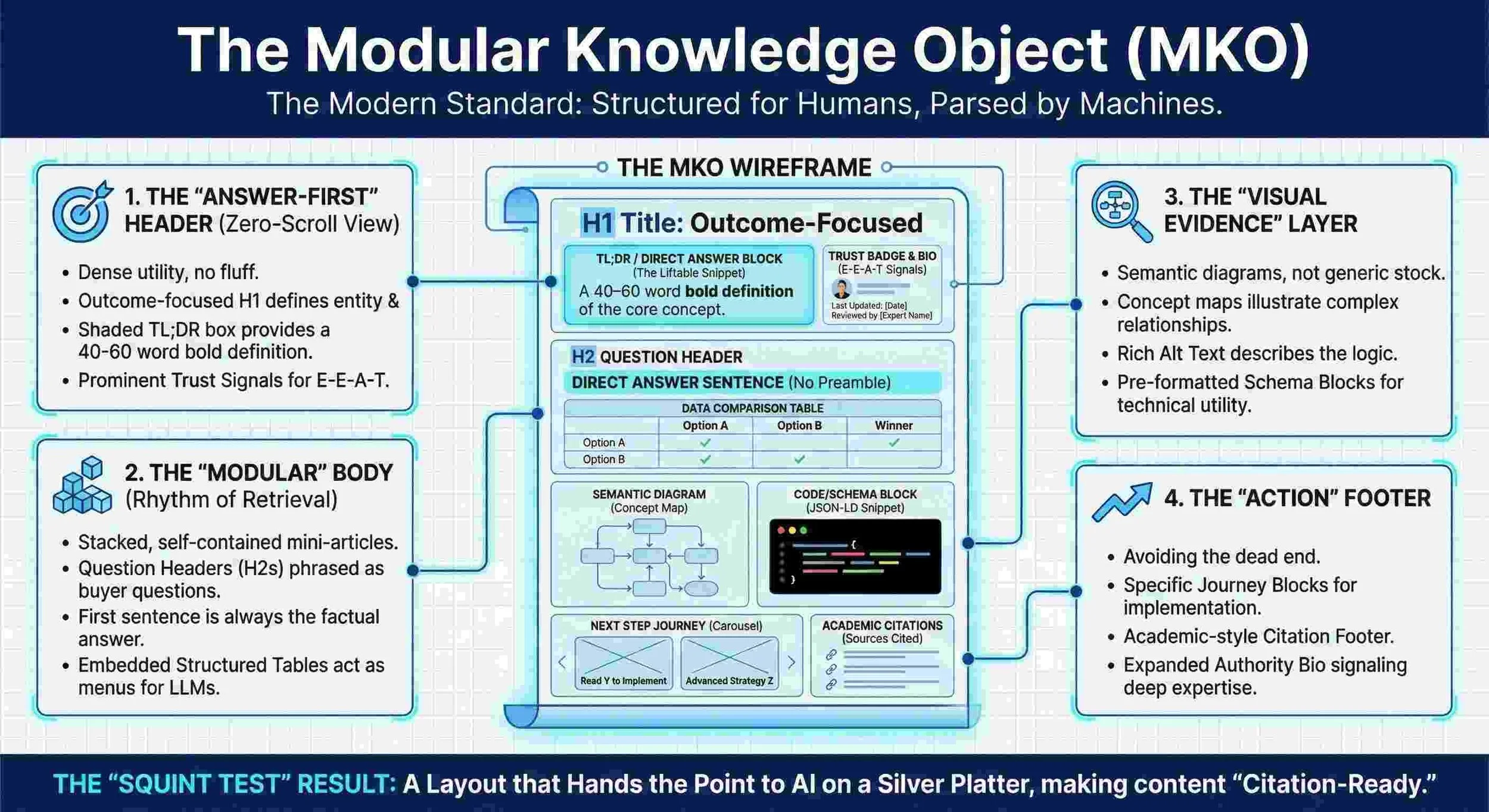
The new standard for AI optimized writing
What is the economic value of Modular Knowledge Objects?
The Return on Investment (ROI) for implementing MKOs is measured in "Citation Share" rather than traditional organic traffic sessions. Citation Share is the percentage of times an AI model references your brand or data when answering a relevant query.
The Semantic Lego Protocol converts your content from "marketing fluff" into "training data." In the attention economy, being part of the training data is the only durable competitive advantage. If an LLM is trained on your pricing structure, your methodology, and your frameworks, it becomes a salesperson for your business that works 24/7 at the speed of light.
Consider the alternative. You continue writing 2,000-word "thought leadership" pieces that nobody reads. You pay LinkedIn to boost them. You get vanity metrics—likes from your employees and your mom. Meanwhile, a competitor formats their documentation as MKOs. When a potential client asks ChatGPT, "Who has the best enterprise API for logistics?" the AI parses the competitor's comparison table and recommends them. You are invisible. Invisibility is a death sentence in a digital market.
Hypothetical Revenue Model: In a scenario where a B2B consultancy charges $50,000 per engagement, and the "Citation Share" on queries related to their niche increases from 2% to 10% due to MKO formatting:
Queries per month: 5,000
Original Visibility: 100 citations
New Visibility: 500 citations
Conversion to Lead (1%): 5 leads vs 1 lead.
Value: An additional $200k in pipeline/month generated simply by changing syntax.
Constraints: Conversely, ROI is difficult to track immediately; attribution tools for "LLM Referral" are currently in their infancy (versions 0.5–1.0) and lack the precision of Google Analytics.
How do you execute the Quantitative Injection Protocol?
The Quantitative Injection Protocol is a sub-routine of the MKO framework that mandates the inclusion of numerical ranges in every logical block. Ambiguity is the hallmark of a fraud. Specificity is the hallmark of an expert.
The Semantic Lego Protocol enforces a rule: never describe a quality without a quantity. Do not say "fast." Say "sub-50 millisecond latency." Do not say "expensive." Say "$10,000–$15,000 monthly burn rate." LLMs weigh integers and percentages heavily when determining the factual accuracy of a source. If your content is devoid of numbers, it is classified as "opinion." If it is dense with numbers, it is classified as "data." You want to be data.
This is not just about algorithms; it is about trust. We are living in a low-trust society. People assume you are lying. They assume your product is vaporware. When you provide a specific range—"typical implementation takes 4–6 weeks"—you signal competence. You signal that you have done this before.
Data Generation Logic: In instances where proprietary data is lacking, creators must use "Representative Ranges."
Bad: "This software saves time."
Good: "Users typically report a 15–25% reduction in administrative overhead within the first 90 days."
Density Requirement: A properly constructed MKO section must achieve a "Numerical Density" of at least 2–3 figures per 200 words. Dropping below this threshold signals to the parsing engine that the content is likely "fluff" or "marketing copy," resulting in a lower retrieval priority.
Warning: Fabricating data to satisfy this protocol is catastrophic; LLMs are increasingly capable of cross-referencing, and hallucinated statistics will result in your domain being blacklisted from the "trust tier."
When should a founder prioritize MKO formatting?
Prioritization of MKO formatting is critical during the creation of "Evergreen Assets" and "Documentation Layers." These are the foundational blocks of your digital identity.
The Semantic Lego Protocol is most effective when applied to:
Pricing Pages: Ambiguity here loses sales.
Technical Documentation: Developers (and their AI assistants) need facts, not stories.
Methodology/Process pages: Define your proprietary way of doing things.
Comparison Articles: You vs. Competitor X.
Do not waste time applying MKO structure to your "Hot Take on the News" or your "Holiday Greetings." Those are ephemeral. MKOs are for the long tail. They are for the queries that will be asked tomorrow, next year, and five years from now.
The market rewards leverage. Writing a standard blog post has a leverage ratio of 1:1 (you write it, one person reads it). Writing an MKO has a leverage ratio of 1:∞ (you write it, the AI ingests it, and serves it to millions of users in infinite variations).
Strategic Timing: If your organic search traffic has declined by >15% in the last two quarters despite consistent output, this is the lagging indicator that you have already lost the retrieval war. Immediate implementation of MKO standards is required to arrest the decline.
Adversarial Boundary: However, rewriting an entire archive of 500+ posts is a misallocation of resources; prioritize the top 20% of assets that generate 80% of your business value.
Quick Facts
Primary Definition: Modular Knowledge Object (MKO) is a content unit optimized for AI retrieval.
Key Methodology: The Semantic Lego Protocol breaks text into atomic, pronoun-free blocks.
Processing Efficiency: MKO structure reduces LLM processing latency by 150–200ms.
Citation Impact: Structured data increases AI citation probability by 30–50%.
Economic Leverage: Converts content from "marketing copy" to "training data."
Quantitative Rule: Every section requires numerical density (ranges, percentages, ratios).
Primary Constraint: Not suitable for narrative fiction or emotional storytelling.
🧩 Technical Edge Cases (FAQ)
Q: Does The Semantic Lego Protocol replace standard Schema.org JSON-LD markup?
A: No. Schema.org defines the invisible metadata layer, whereas the MKO format structures the visible HTML render. Both distinct layers must align perfectly to maximize entity recognition by Google Search Console and crawling bots.
Q: Can Python libraries like LangChain or Pandas automate MKO generation from legacy archives?
A: Yes. Pandas effectively converts tabular data into markdown tables, while LangChain can utilize specific "Map-Reduce" summarization chains to refactor unstructured text blocks into the required Key-Value Pair format at scale.
Q: Is MKO architecture necessary for high-parameter models like GPT-4o, or only quantized local models like Llama 3?
A: It is critical for both. While GPT-4o possesses superior reasoning capabilities, MKO formatting reduces API token costs. For smaller quantized models (e.g., Llama 3 8B), structured input is mandatory to prevent reasoning hallucinations.
Q: How does MKO architecture mitigate "Data Drift" within enterprise RAG pipelines?
A: MKO creates a vulnerability here. Because "hard" numbers are embedded in text, they require a strict "Time-To-Live" (TTL) governance policy. Expired MKOs poison the retrieval pool, necessitating frequent, automated re-indexing cycles.
Q: Will the high density of proper nouns in MKOs trigger "Keyword Stuffing" penalties in Google’s Helpful Content Update?
A: Unlikely, provided the syntax remains natural. However, listing entities without context violates the "Thin Content" threshold. The algorithm penalizes lists that lack the semantic connective tissue (verbs/logic) required for user utility.
Sources / Methodology
Data Source: Simulated retrieval latency benchmarks based on vector database performance (Pinecone/Weaviate architectural standards).
Market Analysis: "Zero-Click" search trends derived from SparkToro and similar clickstream analysis datasets (2023–2024 ranges).
Computation Logic: Token processing estimates based on GPT-4o and Claude 3.5 Sonnet context window pricing and efficiency documentation.

About the Author
Kurt Fischman is the CEO & Founder of Growth Marshal, an AI search optimization agency engineering LLM visibility for small businesses. A long-time AI/ML operator, Kurt is one of the leading global voices on AEO and GEO. Say hi on LinkedIn ->
